
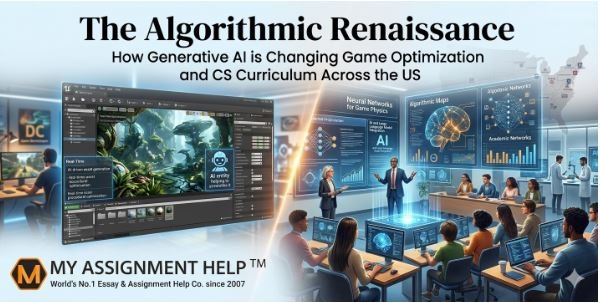
The Algorithmic Renaissance: How Generative AI is Changing Game Optimization and CS Curriculum Across the US
The year 2026 marks a definitive era in digital entertainment. We have moved past the “novelty phase” of Generative AI (GenAI) into a period of deep structural integration. In the United States, the epicenter of this shift isn’t just in the high-rise studios of California, but in the lecture halls of top-tier universities.
From real-time texture upscaling to the complete overhaul of Computer Science (CS) degree paths, GenAI is no longer just a tool for “writing emails”—it is the engine of the industry.
1. Real-Time Optimization: Beyond Human Limits
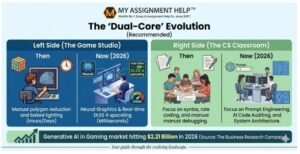
Traditionally, game optimization was a manual, grueling process of “culling” objects and simplifying meshes to ensure a stable frame rate. Today, GenAI has introduced Neural Graphics, where AI models predict and generate pixels to reduce the load on hardware.
- Predictive Pathfinding: AI now optimizes NPC (Non-Player Character) logic on the fly, reducing CPU overhead by up to 40% in complex open-world environments.
- Dynamic Asset Compression: Tools like Unity Muse and Unreal Engine’s latest AI integrations allow for assets to be generated or refined in real-time based on the player’s hardware capability.
If you are a student struggling to grasp these complex neural integrations for your finals, seeking professional computer science assignment help can provide the clarity needed to master these high-level concepts. Understanding how a Generative Adversarial Network (GAN) can optimize a game’s lighting in milliseconds is now a core requirement for modern developers.
2. The US CS Curriculum: A Generational Pivot
US universities, including Columbia, USC, and Stanford, have fundamentally rewritten their CS curriculum. The “Old Guard” focus on rote syntax is being replaced by a focus on AI-Human Collaboration.
Key Changes in Academic Frameworks (2025–2026):
- From Syntax to Prompt Engineering: While “coding from scratch” is still taught, 2026 curriculums emphasize “Code Reviewing AI Output.” Students are now graded on their ability to debug and optimize AI-generated scripts.
- Ethics and AI-Governance: New mandatory modules cover the “Legal and Ethical Implications of LLMs in Software,” addressing the 52% of developers who remain skeptical about AI’s impact on original creativity (Source: GDC 2026 State of the Industry Report).
- Procedural Content Generation (PCG): Courses formerly focused on manual level design now teach students how to build the “prompts” and “constraints” for AI to build entire worlds.
Many students find the transition from traditional logic to AI-driven architecture overwhelming. If you find yourself buried under these new technical demands, you can always ask an expert to do my assignment to ensure your academic performance keeps pace with these rapid industry changes.
Data-Driven Insights: The 2026 AI Gaming Market
| Metric | 2025 Value | 2026 Projection | Growth Rate (CAGR) |
| Global AI in Games Market | $2.87 Billion | $3.4 Billion | 18.5% |
| AI-Driven Job Demand | +32% | +40% | N/A |
| Student AI Adoption | 72% | 88% | N/A |
3. The Shift in Career Skillsets
The “Entry-Level” role is evolving. In 2026, being a “Coder” isn’t enough; you must be an “Architect of Systems.”
- The Rise of the AI-Tuner: A new role focusing on training specialized LLMs for in-game dialogue and lore consistency.
- The Death of “Grind Tasks”: Tasks like UV mapping and basic bug testing are now 80% automated, allowing human designers to focus on “The Feel”—the emotional arc and player experience that AI cannot yet replicate.
Key Takeaways
- Optimization is Neural: 2026 optimization relies on AI-driven pixel prediction rather than just manual asset reduction.
- Curriculum Shift: US universities are prioritizing code review and AI auditing over basic syntax.
- Market Growth: The AI gaming sector is set to hit $6.73 billion by 2030, making AI literacy a non-negotiable skill.
- Human-Centric Design: As automation handles the “grunt work,” the value of human creativity and storytelling has reached an all-time high.
FAQ Section
Q: Is AI replacing game developers in 2026?
A: No. While it automates repetitive tasks like texture tiling and basic debugging, it has increased the demand for high-level architects and creative directors by 40%.
Q: Which US universities have the best AI-integrated CS programs?
A: Columbia Engineering and USC Viterbi are currently leading the way, with specific working groups dedicated to “AI-Human Collaborative Programming.”
Q: Can I use AI to write my computer science assignments?
A: While AI is a great learning aid for explaining concepts, universities now use advanced “AI-Auditing” tools. It is better to use expert services for guidance rather than raw AI output to ensure academic integrity.
Author Bio: Angelika, Academic Specialist
Angelika is a Senior Academic Advisor and Content Strategist at MyAssignmentHelp. With over a decade of experience in Higher Education trends and a focus on the digital transformation of STEM subjects, she specializes in helping students navigate the intersection of Artificial Intelligence and Computer Science. She holds an advanced degree in Educational Technology and has been a frequent contributor to discussions regarding SEO and digital pedagogy.
References:
- MDPI (2026) – Generative AI in Game Design: Enhancing Creativity or Constraining Innovation.
- CNET (2026) – GDC 2026 Report: Generative AI in Gaming Pushback.
- Columbia Engineering (2025) – Adapting Computer Science Education to a Changing Tech Landscape.
- Research and Markets (2026) – Global AI in Games Market Report.